Six Lines, One Page: Turning Your About Page Into a Closing Argument

Go look at your About page right now. I'll wait.
Odds are it opens with something like "Founded in 2017, we are a passionate team dedicated to delivering excellence." Which is fine, except it says nothing, proves nothing, and asks for nothing. It's a bio wearing a marketing hat.
Meanwhile, the person reading it is already warm. They've seen your pricing or your portfolio. They clicked About because they wanted one last reason to trust you before they fill out the form. You have maybe forty seconds of their attention, and you're spending it on your founding year.
Six sentences fix this. Not six paragraphs — six sentences, each doing a job. Write them in order, keep them short, and let the page breathe around them.
Sentence 1: the origin line with a number in it
"We started in 2019 after watching three clients in a row get quoted $14,000 for a website that couldn't take a payment."
A specific origin story beats a generic mission statement every time. The number is what makes it credible — it's a detail a person wouldn't invent. Swap in your own receipt: a dollar figure, a count, a date that matters.
If your origin is unglamorous, lean in. "I got laid off in March 2020 and had two clients by June" is a better trust signal than anything involving the word "passion."
Sentence 2: who you actually work with, in their words
"Most of our clients are restaurants and independent retail shops doing between $400K and $3M a year, usually with one person handling all the marketing."
This sentence does two things at once. It tells the right reader "that's me," and it tells the wrong reader to leave before anyone wastes a call. Both outcomes are wins.
Resist the urge to broaden this. "We work with businesses of all sizes" means you have no idea who you're good at serving.
Sentence 3: the honest disqualifier
"We're probably not a fit if you need a full rebrand in under three weeks, or if you want someone to just take orders without pushing back."
Most About pages are scared of this sentence. It's the most persuasive one on the page. Naming who you aren't for signals confidence, and it makes everything else you claim more believable.
Keep it specific and non-insulting. "We're not for you if you want the cheapest option" is a cliché. "We're not a fit if your team can't commit to a 30-minute weekly check-in" is a filter.
Sentence 4: the proof sentence with a real number attached
"Across 61 projects, the median client has been with us for just over three years."
Not "we pride ourselves on client satisfaction." A number someone could check if they were the checking type. Retention rate, average turnaround, number of jobs completed, percentage of clients who came from referrals — pick the one that's true and specific.
If you don't have impressive numbers yet, use a small honest one. "We've done fourteen of these" beats "hundreds of satisfied customers" every single time.
Sentence 5: what actually happens after they say yes
"Here's the deal: a 30-minute call, a written scope in four business days, and no invoice until you approve the plan."
Buyers are not scared of work. They're scared of the unknown. Telling them the sequence — call, quote, kickoff, first deliverable — removes the last flicker of hesitation that sends someone back to the search results.
Bonus points if you name the person. "You'll talk to Dana, not a sales rep" is worth a paragraph of reassurance.
Sentence 6: one instruction, not three
"If that sounds right, grab a 20-minute slot here — or reply to any email I've sent you and I'll answer personally."
One primary action. One fallback for people who aren't ready to book. That's it. Every additional button on an About page splits attention and lowers the response rate.
Where the sentences go
Don't bury them in a wall of text. Format matters as much as wording:
- Sentences 1 and 2 sit at the top, above any photo.
- Sentence 3 gets its own short section with a subhead like "Who this isn't for."
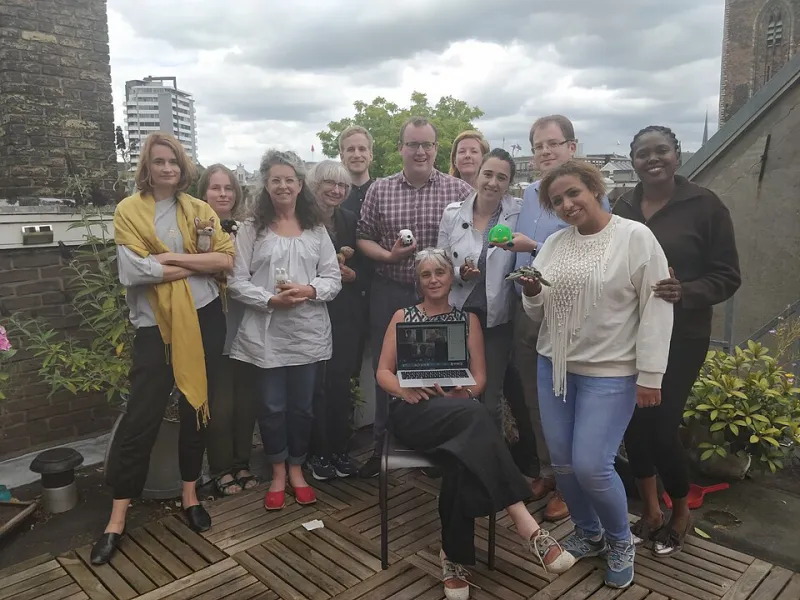
- Sentence 4 goes near a photo of the actual humans, captioned with names.
- Sentence 5 lives in a short list so it's scannable.
- Sentence 6 appears twice — once after sentence 5, once at the bottom — because people scroll and then forget.
Add a real photo. Not the stock one with the conference table and the inexplicable bowl of limes.
Test it the cheap way
Drop the six sentences into a page, then send the link to five recent customers and ask one question: "Does this sound like what we actually did for you?" If three say no, your sentences describe the business you wish you ran. Rewrite them until they describe the one you've got.
Then check your form submissions for a month against the same month last year. This is not sophisticated testing. It's the kind that actually gets done.
Your About page is not a formality. It's the last thing a warm prospect reads before deciding. Give it six sentences that earn the click.